
A brand runs a campaign, generates leads, converts customers and reports a healthy return on advertising spend. The next month, it runs another campaign to achieve similar results. The process repeats, and the marketing dashboard continues to look encouraging.
Then the advertising budget is reduced. Enquiries fall. Website traffic slows. Sales begin to feel the impact.
This raises an important question: has the business actually grown, or has it become increasingly dependent on paid campaigns to maintain its sales?
It is a question worth asking because digital advertising can generate impressive short-term results without necessarily strengthening a business’s ability to attract customers in the future.
Is your marketing generating sales today, and is it making it easier to generate sales tomorrow?
That is the difference between measuring campaign performance and evaluating sustainable marketing growth.
A good ROAS tells only part of the story
Return on ad spend (ROAS) is an important performance metric. It helps businesses understand how much revenue their advertising generates in relation to the money invested. Cost per acquisition, conversion rates and lead generation numbers provide equally useful information when evaluating campaigns.
However, these metrics need context.
A campaign can deliver a strong ROAS because it reaches people who are already familiar with the brand, actively searching for the product or close to making a purchase. The campaign captures existing demand efficiently. That is a valuable outcome, but it does not necessarily mean the brand is attracting more potential customers or strengthening its position in the market.
Consider a business that relies heavily on paid search. People searching for its products find its advertisements, visit the website and convert. The campaign performs well. But how many people would search for that brand by name if its advertising disappeared? How many would discover it through organic search, social media, recommendations or previous experiences?
Short-term performance and long-term marketing growth serve different purposes, and businesses need to understand what each contributes.
| Short-term performance | Long-term marketing growth |
|---|---|
| Generates immediate leads, enquiries and sales | Builds future demand and brand preference |
| Captures people who are ready to buy | Creates familiarity among people who may buy later |
| Often driven by campaigns, offers and paid acquisition | Developed through consistent brand and digital presence |
| Measured through ROAS, CPA, conversions and revenue | Evaluated through brand interest, organic discovery, retention and customer value |
| Helps achieve immediate business targets | Strengthens the ability to attract and retain customers over time |
These are complementary outcomes. A business needs both, and a well-planned campaign can contribute to each. The challenge is recognising that immediate conversions tell only part of the story.
The sale today and the customer who buys tomorrow
Performance marketing and brand building serve connected purposes.
Performance campaigns help businesses reach people who are ready to take action. They can generate enquiries, encourage purchases, promote offers and support specific commercial targets.
Brand building helps people recognise, remember and develop a preference for a business before they enter the buying process. Consistent communication, useful content, distinctive creative, social presence and positive customer experiences all contribute to this process.
The distinction becomes particularly important when we consider how people make purchasing decisions.
For example: Someone buying a product today may have discovered the brand months earlier. They may have seen a social media post, read an article, noticed a recommendation or encountered the brand through a search. When the need finally arises, that familiarity can influence which businesses they consider.
The original exposure may have happened long before the eventual conversion. A last-click report or a short campaign attribution window may give very little credit to those earlier interactions.
Research from Kantar, analysing around 50,000 advertisements tested over five years, found that approximately two-thirds performed similarly on brand-building and sales-activation measures. Its analysis also highlighted that some campaign sales effects remained visible well beyond the initial reporting period.
Read Kantar’s research on brand building and performance marketing.
This offers an interesting perspective for digital marketers. A campaign designed to generate immediate conversions can also strengthen brand recognition. Consider what this means for the digital marketing activities businesses invest in every day.
- Paid campaigns: Does your campaign give people a reason to buy while helping them remember the brand? The creative, messaging and product presentation should contribute to brand recognition alongside the immediate offer.
- Social media: Does your communication build familiarity and trust over time, beyond immediate likes, reach and engagement? Consistent and recognisable communication helps audiences develop an understanding of what the brand stands for.
- Content marketing: Does your content answer questions that bring potential customers closer to a purchase while improving organic discoverability? Useful articles, guides and other relevant content can help a business reach people at different stages of their decision-making process.
- Website: Does your website convert today’s visitors while giving future visitors the information and confidence they need to consider your business? Clear positioning, useful information, credibility signals and a good user experience all influence how people evaluate a brand.
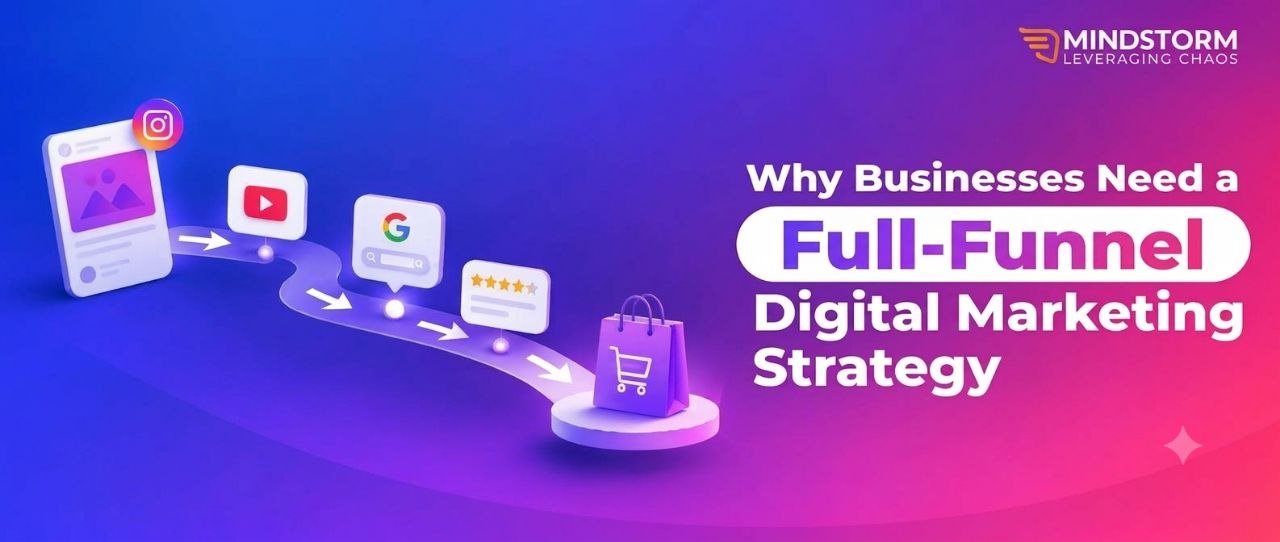
Each interaction can contribute to a different stage of the buying journey. Someone might discover a brand through social media, explore its content later, search for it when a need arises and eventually convert through its website.
How much should a brand invest in building its name?
This is where marketing strategy needs to account for the brand’s current position, its audience and the category in which it operates.
At Mindstorm, when working with a new or relatively unknown brand, we often recommend starting with an allocation of approximately 80% towards brand building and 20% towards conversion-focused activity.
The reasoning is straightforward. People need to know the brand exists, understand what it offers and have a reason to consider it. Investing heavily in conversion campaigns before establishing that foundation can make acquisition more difficult and expensive.
As the brand develops recognition and builds a customer base, the allocation can evolve. An established brand with strong awareness and recall may be able to direct a larger share towards conversion activity, while continuing to invest in brand relevance and future demand.
These percentages are a starting recommendation, rather than a formula. The audience matters just as much as the brand’s age.
A legacy brand may enjoy strong recognition among older consumers, yet have very little relevance among Gen Alpha. For that younger audience, the brand could be virtually unknown. It may need to invest substantially in discovery, cultural relevance and brand communication, even though it has been in the market for decades.
The category also changes the equation.
For example, in food and beverage, purchasing habits and familiarity can play a significant role in repeat consumption. A brand may benefit from established preferences, while still needing to remain visible and relevant as new competitors enter the market.
Apparel can involve a different set of considerations. Trends, seasons, changing tastes and new collections continually give consumers reasons to explore alternatives. An established apparel brand may need strong brand-led campaigns to reconnect with a particular audience or introduce a new collection. A conversion campaign alone may struggle to create that renewed interest.
This is why marketing budgets should reflect the brand’s actual growth challenge.
Is the business trying to introduce itself to a new audience? Build consideration? Regain relevance? Generate immediate sales? Encourage repeat purchases? Each objective calls for a different emphasis.
What does sustainable marketing growth actually look like?
Over time, a healthy marketing strategy should create more opportunities for people to discover, consider and choose a business. This happens when different digital channels contribute to the same customer journey.
A person might first encounter a brand through a social media campaign. They may search for it a few days later, discover an informative article through Google, read customer reviews and eventually visit the website before making a purchase. A positive experience may bring them back or encourage them to recommend the business.
Each interaction has a role in building that relationship.
1. More ways for customers to discover the brand
A business that depends almost entirely on paid advertising has limited flexibility in how it generates demand. SEO, useful website content, social media and online reputation can create additional discovery opportunities.
Organic growth takes time and investment. It also requires consistency. A business should examine whether organic visitors are relevant, whether they engage with its offering and whether that discovery contributes to enquiries or sales.
2. Stronger brand interest
An increase in branded searches, direct website visits and enquiries from people already familiar with the business can offer useful signals of growing brand interest.
These indicators need context. Existing customers and seasonal demand can influence them too. However, when viewed alongside awareness, consideration and sales trends, they can help reveal whether more people are actively seeking out the brand.
3. Better customer quality and repeat behaviour
Acquiring a customer is one part of the growth equation. What happens after the first purchase matters too. Do customers return? Do they recommend the business? Does the relationship generate repeat revenue? Are acquisition costs justified by the value and margin those customers contribute over time?
A business that continually replaces customers through paid acquisition may have a very different growth position from one that attracts new customers while retaining existing ones.
4. A connected digital marketing ecosystem
SEO, social media, content, website experience, online reputation and paid advertising should reinforce one another.
A potential customer might first encounter a brand through Instagram, search for it on Google, read reviews, visit the website and eventually enquire. Each interaction contributes to the decision.
This is what a connected digital marketing ecosystem should achieve: more ways for customers to discover the business, stronger reasons to consider it and better opportunities to return.
Businesses can look for signs of this progress through branded search trends, direct website visits, relevant organic traffic, customer retention, repeat purchases and referrals. These indicators need to be considered alongside acquisition costs, customer quality and profitability. Traffic or engagement alone cannot establish sustainable growth.
Today’s marketing investment must work for tomorrow’s sale
Sustainable marketing growth develops through consistent decisions over time. It requires businesses to look beyond monthly campaign reports and understand how their marketing contributes to customer acquisition, brand relevance, retention and future demand.
Paid campaigns will continue to play an important role. They help businesses reach new audiences, capture existing demand, support launches and generate measurable returns. Brand building, SEO, content, social media and customer relationships strengthen the wider ecosystem in which those campaigns operate.
The balance will change as a business grows, enters new markets, targets different audiences or responds to shifts in consumer behaviour.
What should remain consistent is the way success is evaluated. Immediate campaign performance deserves attention, alongside the longer-term signals that indicate whether the business is becoming easier to discover, more likely to be considered and better positioned to acquire customers.
At Mindstorm, we look at digital marketing as a connected business growth function. From paid campaigns and social media marketing to SEO, website development, content and online reputation management, each activity needs a clear role in the larger strategy.
Because the real measure of marketing growth is bigger than the return from the latest campaign.
It is whether the work you do today gives your business a stronger starting point for tomorrow.
If you’re reviewing your current marketing strategy and want to understand where your investment is delivering value, speak to a digital marketing consultant or explore how Mindstorm can help build a more connected digital marketing strategy.