
Most marketing audits we run start the same way. A brand comes in confident about its acquisition numbers, showing us a conversion campaign that performed well for six to nine months, and then asks why the same campaign now needs twice the budget to produce the same result. Most people think that something went wrong with their ad account but that’s not the real scenario. The brand simply built its entire marketing effort around one stage of the customer journey, and that stage eventually ran out of the audience it depends on.
A conversion campaign is built to close a sale with someone who is already close to deciding. It isn’t built to create that readiness in someone who has never heard of the brand. For a while, this distinction doesn’t matter, because every market has a pool of people already primed to buy the moment the right ad reaches them. Once that pool is exhausted, the campaign doesn’t get worse at its job, the audience for that product or service is exhausted and the campaign is no longer looking for that audience.
Why This Keeps Happening to Otherwise Well-Run Brands
This pattern repeats across categories, from D2C skincare to SaaS to boutique retail, for a fairly simple reason: conversion spend is the easiest part of marketing to defend. It produces a clean number, spend this much, get that much back, and that clarity makes it the first thing a brand funds and the last thing it cuts.
Awareness spend doesn’t offer the same comfort, since its effect shows up weeks later, often in a retargeting campaign that suddenly performs better than it should. We’ve covered this in more detail in our piece on social media marketing as an investment, which gets into why the return on these stages rarely shows up in the same month the money goes out, and why that delay makes awareness the first budget line to get cut when a quarter looks tight.
This also tracks with how differently people actually shop today. According to Think with Google’s research on consumer decision-making, buyers no longer follow a straight path from awareness to purchase. Instead, they interact with a brand multiple times across different channels before buying. A marketing strategy that only focuses on two or three touchpoints right before the sale ignores how modern buyers actually make decisions.
What a Full-Funnel Strategy Is Actually Solving For
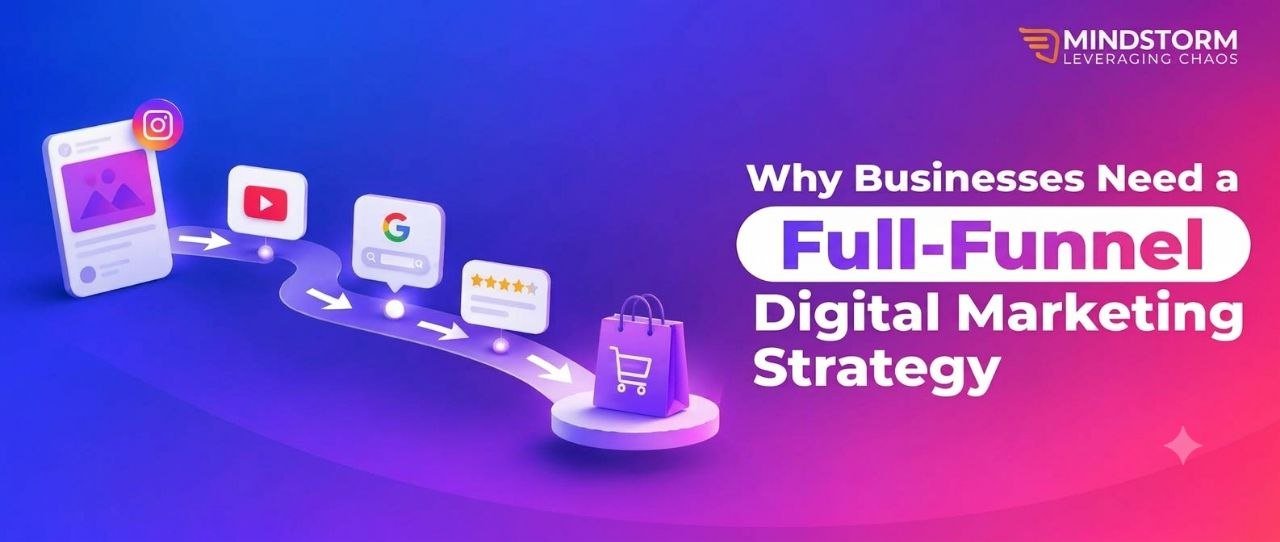
A full funnel digital marketing strategy isn’t an argument for running more campaigns. It’s an argument for giving each stage of the customer journey its own job, and judging it against that job, instead of asking one conversion ad to introduce the brand, build trust, and close the sale all at once.
- At the top, the goal is to reach people who don’t know the brand yet. This usually happens through content, video, and social media. So it should be judged by attention and recall, not by immediate sales.
- In the middle, the job shifts to building enough familiarity that interest turns into intent, typically through retargeting, proof points.
- Only at the bottom does the campaign finally ask for the sale, and by then it’s working with a warmer, better-informed audience than any cold conversion campaign reaches on its own.
In the end, it’s not about which platform you use. It’s about whether all your platforms are working together as one system. A related point we explored in our article on cross-channel marketing is that someone who saw a reel three weeks ago should be recognised, not treated as a stranger, when a retargeting ad reaches them today. Brands running Instagram, search, and email as three disconnected efforts tend to lose exactly this continuity, and lose it without ever realising why their conversion numbers feel inconsistent month to month.
What Happens When Ready-to-Buy Customers Become harder to Reach?
Take a mid-sized D2C nutrition brand that built its first year of growth almost entirely on conversion campaigns targeting people already searching for protein supplements. The approach worked well while that search pool was large relative to spend.
As the budget grew, the brand widened its targeting to sustain volume, and cost per acquisition crept up steadily over several months, with no real change in creative or offer. An audit of the account showed a familiar split: click-through rates on the newer campaigns were strong, but conversions on those same campaigns had fallen by nearly half compared to the brand’s original audience. The ads were reaching people, just not people with any prior familiarity with the brand, which meant every click was effectively a cold introduction disguised as a conversion opportunity.
If you’re seeing a similar gap between clicks and actual sales,read our breakdown of why high CTR often fails to translate into conversions, since the underlying cause is usually the same.
Once this brand introduced a starter brand awareness campaign layer, built around short content addressing common objections before any sale was attempted, its retargeting and conversion campaigns recovered efficiency within two months, without any increase in bottom-of-funnel spend.
What This Means for How Brands Should Think About Budget
The point here isn’t that awareness spend matters more than conversion spend. It’s that the two aren’t substitutes for each other, and funding one while starving the other eventually caps what the funded stage can achieve on its own. How a brand should split its budget depends on which lifestage of the consumer’s journey it is right now. A new brand needs to spend more on awareness because it has no audience to retarget yet. On the other hand, an established brand can focus more on retention, since its past awareness investment is still paying off in the background.
This becomes even more important when a brand is trying to scale without simply inflating its budget. Our piece on how top marketers grow aggressively while keeping costs disproportionately low gets into this exact tension: the brands getting more out of the same spend are usually the ones who’ve worked out which stage of the funnel is genuinely under-resourced, rather than the ones pouring more money into the stage that’s easiest to measure.There’s also a tendency to treat the funnel as something that ends at checkout, which overlooks where a meaningful share of long-term profit actually comes from. This is not new—research from Frederick Reichheld at Bain & Company showed long ago that acquiring a new customer costs far more than keeping an existing one, and even a small improvement in customer retention can lift profit significantly.
A customer retention strategy that stops optimising the moment a sale closes leaves one of its highest-return stages almost completely unmanaged. If you’re thinking about how to act on this, read our take on why marketing automation is more than sending emails, since the real value isn’t in messaging people more often, it’s in recognising a returning customer and responding to them differently than you would to someone buying for the first time.
Don’t leave your ad campaigns to Chance. Strategize
Sustainable growth starts when every stage of your marketing works together.
Conversion campaigns are excellent at capturing demand. The challenge is that they cannot create demand on their own. Brands that understand this distinction tend to scale more predictably than those that keep asking the bottom of the funnel to do the entire job. If your current marketing is concentrated almost entirely at the point of sale, that’s usually a sign the earlier stages of the journey are being left to chance rather than design. A digital marketing consultant can help identify exactly where that gap sits and what it’s costing in acquisition efficiency. Mindstorm, a digital marketing agency in Mumbai, works with brands on building this kind of connected strategy from the ground up.