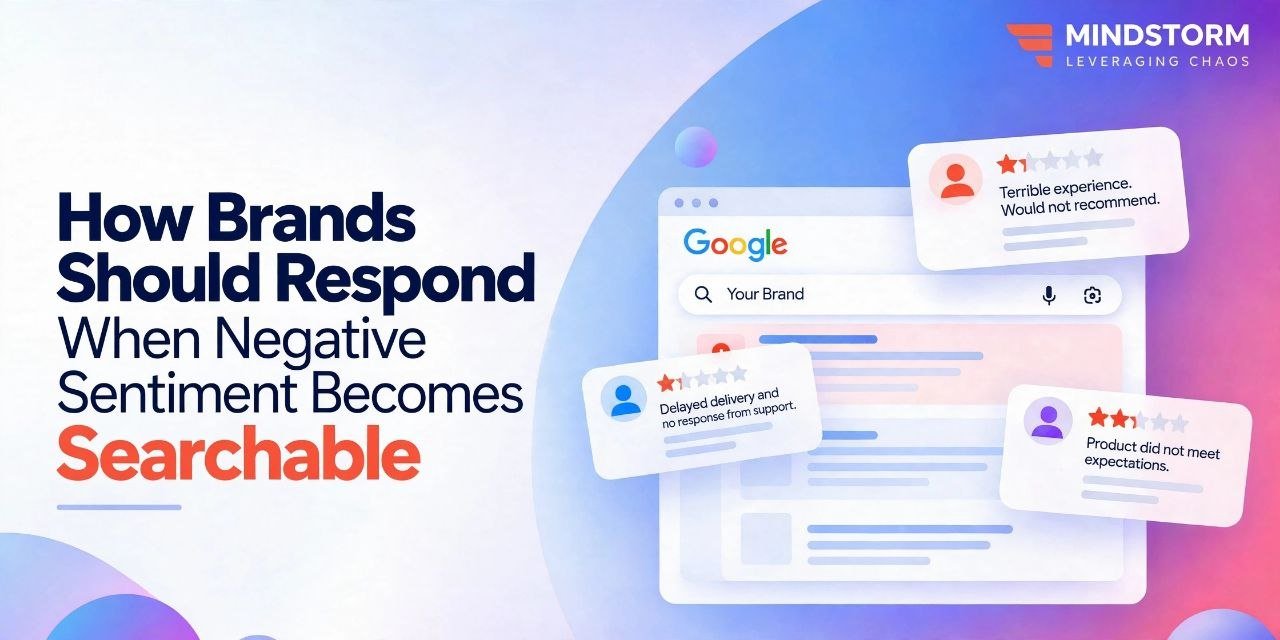

Most reputation conversations we have with brands begin with a screenshot. Someone from the marketing team searches the brand name, finds a complaint thread, a one-star review or an old news report sitting on the first page, and sends it across with one line: “Since when is this showing up?” The honest answer is usually that it was always there. What changed is that search made it easy for anyone considering the brand to find it.
That is the real shift behind negative brand sentiment today. A frustrated customer used to tell a handful of friends, and that was where the story ended. Now the same complaint is indexed, ranked and shown to every person who types the brand’s name, including the ones who were two clicks away from buying. A service issue becomes part of the brand’s first impression.
How Does Negative Sentiment Affect Brand Reputation?
Because people now check before they commit. BrightLocal’s Local Consumer Review Survey 2026 found that 97% of consumers read reviews while choosing a local business and that the average consumer looks across six different review sites. So brand reputation in search results is rarely decided by one review. It is decided by the overall impression of everything that shows up when the name is searched.
A prospective customer is not only checking Google reviews; they’re evaluating you across Reddit, Quora, Amazon and sometimes even across websites that have nothing to do with buying a product, such as Glassdoor or Ambitionbox. The sphere of influence is vast, and the cost of negative reviews is not limited to a lost sale. Negative coverage can weaken trust and make potential customers reconsider a purchase. It also makes marketing ad spends moot, because the ad that earned the click now sends the visitor straight into doubt. Brands that spend on awareness and then lose people at the search stage usually blame creative or targeting when the leak is the brand’s reputation and brand perception.
How Should Brands Respond to Negative Search Results?
Most first reactions are wrong. Brands try to get the result removed, argue with the reviewer in public, or flood the page with positive posts in the hope that it gets pushed down. Each of these has its place on occasion, but understanding brand reputation management and customer relationship management is the key to solving this. Begin by treating the problem as two separate jobs: handling the real issue at hand, responding to customer emotion and managing what the search page shows. Both need different handling and an expert understanding of the human psyche as well as technical management.
Every negative search results brand audit we run ends up with the same three buckets:
- A genuine complaint: the customer had a real problem. The response is a quick, specific public reply and a real fix, not a defence.
- An outdated issue: the problem was resolved long ago, but the page still ranks. The response is to update the record, ask for the review or thread to be revisited, and publish fresher content that tells the current story.
- A false or malicious result: this calls for platform reporting and, in serious cases, legal support. It does not call for an argument in the comments.
Treating all three the same way is where most brands lose time. A brand that argues with a genuine complaint makes it more visible, and a brand that stays silent about a false one lets it settle in.
What Should Brands Do About Negative Reviews on Google?
Google reviews are the most visible kind of searchable negative reviews, since they sit right beside the brand name in search and on maps. The rule we follow is to reply for the reader, not the reviewer. The person who wrote the review has already made up their mind, but the next hundred people reading it have not. A good public reply is short, names the actual issue, takes ownership where the brand is at fault, and moves the conversation to a direct channel. Copy-pasted apologies do more harm than silence, because readers spot them in a second.
Timely responses show customers that the brand is paying attention. The appropriate response time depends on the issue, but complaints involving refunds, delivery failures or other unresolved problems should be acknowledged promptly.
Reviews that break the platform’s policies, such as fake or spam ones, should be flagged through Google rather than answered. And the one shortcut to avoid is asking only your happiest customers for reviews or offering incentives for them, which goes against Google’s review guidelines and tends to backfire the moment it is noticed.
How did Mindstorm solve Vijay Sales’ ORM as volume increased?
Volume changes how all of this works. When Vijay Sales grew from around 40 queries a day in 2014 to 200 to 300 across platforms, we had to move from individual, improvised replies to a standardised, process-led response system the team could scale. We’ve shared how it worked in our ORM case study on Vijay Sales, and it is a useful reference for any brand whose review and query volume is outgrowing its team. A standardised response process helps teams manage growing query volumes. But it does not control what appears when someone searches for the brand. An unresolved complaint can still become a potential customer’s first impression.
What Happens When a Complaint Becomes the Brand’s First Impression?
Consider a mid-sized D2C skincare brand that had a strong launch year and a steady advertising budget. A few months later, a customer thread about delayed refunds began appearing on the first page of search results for the brand name. The marketing team’s instinct was to push it down with more positive content, and for a while that was all they did. Click-throughs from ads stayed healthy, but conversions from branded search slowly softened, because the people most ready to buy were exactly the ones checking the brand name first.
The response required changes beyond marketing. The brand replied to the thread, worked with its operations team to fix the refund timeline, and published a clear refund and returns page that answered the exact questions the thread had raised. The complaint did not vanish, and it did not need to, but the brand’s own page now ranked beside it. The lesson is that negative brand sentiment built around a repeated issue, whether delivery, refunds or support, is an operations signal. The fix needs to begin internally, with the first complaint itself. By the time it ranks, it has already spent weeks in comments, DMs and marketplace reviews.
How Can Brands Manage Negative Online Sentiment Before It Gets Indexed?
Negative sentiment that eventually appears in search results often begins in social media comments, direct messages or marketplace reviews. Monitoring these spaces gives a brand time to respond before a post gets screenshotted into a forum thread or an article. It also shows patterns. If the same complaint appears every month, grouping it by theme and sending it to the team that owns the problem will do more for the brand’s reputation than any reply.
When negative sentiment rises suddenly, brands need to respond faster and coordinate decisions across marketing, customer support and operations. Our crisis management case study for the Tourism Authority of Thailand gets into how a crisis management strategy helped limit the damage in a situation like that.
How Can Businesses Protect Their Search Reputation?
By owning more of the first page. The brand website, Google Business Profile, social profiles, review profiles, press mentions and policy or FAQ pages all compete for space when someone searches the name, and complete, current pages tend to hold their ground. Make sure there is a page that answers each recurring complaint, so the brand’s side of the story is as easy to find as the complaint itself. This is where SEO and reputation work meet and our piece on the importance of SEO for brand building covers how the same fundamentals of credibility and visibility decide which pages claim that space.
The page of blue links is also no longer the only place a negative SERP reputation shows up. As we noted in our guide to AI search optimisation, search reputation also matters as people increasingly use AI-powered tools to research brands. Depending on the system and its sources, negative coverage may appear in AI-generated answers as well as traditional search results. This makes it important for brands to monitor their reputation across multiple search experiences. It is one more reason to treat reputation as a continuous search activity rather than a clean-up job.
Don’t Wait for the Screenshot to Start Managing Your Search Reputation
Negative sentiment can reach search results even when a brand is taking steps to improve its customer experience. What matters is whether potential customers can also find accurate information, a thoughtful response and evidence that the underlying issue is being addressed. A brand-name search deserves the same attention as other important customer touchpoints. An online reputation management strategy can help brands monitor search results, respond to complaints and strengthen the content that appears alongside them. Mindstorm, a digital marketing agency in Mumbai, works with brands on reputation monitoring, response management and search visibility.