
Your Google Ads report shows 45 conversions. Meta reports 38. Google Analytics tells you that 52 conversions came from your paid and organic channels.
You know how many purchases or enquiries your business actually received, but when you look at the marketing reports, the numbers tell different stories. Which platform performed better? Which channel deserves credit? And more importantly, where should the next marketing budget go?
This is a familiar challenge for businesses running campaigns across multiple digital platforms. The discrepancy often creates confusion, particularly when teams are expected to demonstrate the return on every marketing investment.
The explanation lies partly in how attribution works. Different platforms and attribution models have different ways of recognising marketing interactions and assigning credit to conversions.
Understanding these differences is important because the model you use influences how you interpret performance, evaluate channels and make budget decisions.
One customer journey, multiple versions of the same conversion
Take for example a common customer journey – it begins with someone discovering a protein brand through an Instagram advertisement, but they don’t purchase immediately. A few days later, they search for the brand on Google, visit its website through an organic result and explore a few products. A week later, they return through a Google Search advertisement and complete a purchase.
Which channel generated the sale?
- Instagram introduced the brand to the customer.
- Organic search brought them back.
- Google Search was the final advertising interaction before the purchase.
- Each channel played a different role in the journey. However, the way that contribution is recorded depends on the attribution model being used.
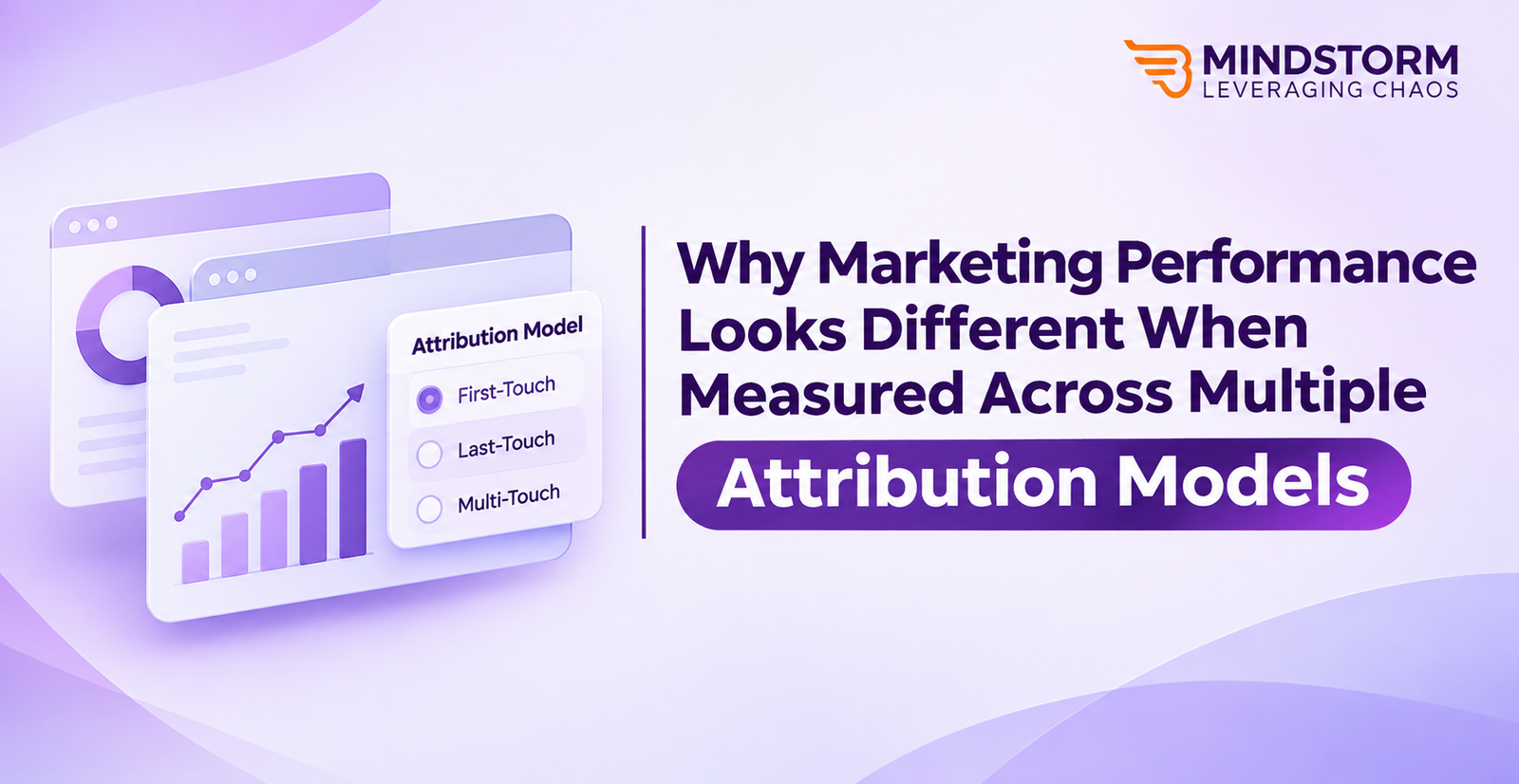
Attribution is the process of assigning credit to marketing interactions that occur before a conversion.
It helps businesses understand which touchpoints receive recognition for an enquiry, purchase or another important action. A last-click attribution model assigns all eligible conversion credit to the final interaction. In our example, Google Search would receive the credit.
A data-driven attribution model takes a different approach. It analyses available conversion paths and interaction patterns to estimate the contribution of different touchpoints. The credit may therefore be distributed across multiple eligible interactions.
Multi-touch attribution is the broader approach of recognising several interactions along the customer journey, rather than assigning all credit to a single touchpoint. The way that credit is distributed depends on the model being used.
Google Ads currently supports last-click and data-driven attribution. Its older first-click, linear, time-decay and position-based models are no longer supported. Google Analytics 4 also offers data-driven and last-click reporting for paid and organic channels.
Google explains how its attribution models work and how they distribute conversion credit.
The important point is that the business has recorded one purchase. The attribution models are simply offering different interpretations of the marketing interactions that preceded it.
Why Google, Meta and Analytics don’t always agree
Attribution models are one reason reports differ. Platform-specific measurement settings are another.
Google Ads, Meta Ads and Google Analytics don’t necessarily observe or evaluate the same interactions in the same way. Each platform has its own reporting environment, conversion definitions and attribution settings.
Here are some of the factors that influence the numbers.
1. Different attribution windows
An attribution window determines how long after an eligible marketing interaction a conversion can receive credit.
For example, someone may view an advertisement today and purchase several days later. If the platform’s attribution settings allow that interaction to receive credit, the conversion may appear in its report.
Different platforms and campaign types can use different attribution windows. Consequently, the same purchase may qualify for credit in one report but fall outside the reporting window of another.
2. Click-through and view-through conversions
A customer doesn’t always click an advertisement before purchasing.
They may see a Meta advertisement, remember the brand and later search for it independently. Depending on the campaign’s attribution settings, Meta may report a view-through conversion if the purchase occurs within its eligible window.
Google Search may also receive credit if the customer subsequently clicks a search advertisement and completes the purchase.
Both platforms can therefore report a contribution to the same business outcome. This does not mean the business received two purchases.
3. Different conversion definitions and counting methods
What exactly counts as a conversion? For an ecommerce business, it may be a completed purchase. For a service business, it could be a form submission, a phone enquiry or a qualified lead.
Even when platforms track the same action, differences in conversion counting, event configuration and reporting scope can affect the totals.
A business should also check whether it is comparing the same conversion actions across platforms. Comparing purchases in one report with all website enquiries and other tracked events in another will naturally produce different numbers.
4. Reporting time zones and conversion timing
Even when conversion tracking is configured correctly, reports may use different time zones or record conversions according to different dates.
For instance, Google Ads uses the account time zone, while Google Analytics uses the property time zone. A conversion occurring near midnight may therefore appear under different reporting dates.
Google’s documentation outlines these and other reasons for discrepancies between Google Ads and Analytics reporting. Google’s guide to conversion reporting differences is useful when investigating why the same conversion action produces different totals.
There is another important consideration: platforms can each claim credit for the same conversion. Adding the conversion totals from Google and Meta together can therefore overstate the number of actual business outcomes. The business’s own order records, CRM or verified lead data should remain the reference point for how many purchases or enquiries actually occurred.
Attribution tells you who gets credit. Does it tell you who caused the sale?
This is an important distinction that businesses often overlook. Attribution helps us understand how conversion credit is distributed across marketing interactions. It does not automatically establish whether those interactions caused the conversion.
Consider a customer who has already decided to purchase from a brand. They have visited the website, compared products and are close to completing the transaction. Just before purchasing, they see a retargeting advertisement, click it and complete the order.
The advertising platform may attribute that conversion to the retargeting campaign. But would the customer have purchased anyway? This is where attribution and incrementality become two different questions.
Attribution asks which marketing interactions receive credit for a conversion. Incrementality asks how many additional conversions happened because of the marketing activity that would not otherwise have occurred.
The distinction matters when evaluating campaigns that target people who already know the brand or have shown strong purchase intent. A campaign can report impressive conversion numbers while contributing fewer additional sales than the report might suggest.
Controlled experiments, holdout groups and lift studies can help businesses investigate this. For example, a suitable group of potential customers may be kept unexposed to a campaign, allowing the business to compare outcomes between those exposed to the advertising and those who were not. A more sophisticated attribution model can offer a broader view of the customer journey. However, it should not automatically be treated as proof of incremental business impact.
How should businesses use attribution when deciding where to invest?
There is no single attribution model that works equally well for every business. The choice should reflect the customer journey, the marketing channels being used, and the decision the business wants to make.
For example, a business with a relatively short buying cycle and a limited number of marketing touchpoints may find last-click reporting useful for understanding immediate conversion activity.
A business investing across social media, paid search, video, content and other channels may need a broader view of how customers interact with its marketing before converting. Data-driven attribution and multi-touch analysis can help reveal interactions that last-click reporting may overlook.
Similarly, a business investing heavily in awareness and prospecting campaigns should be careful about evaluating every channel solely through final-click conversions. Some channels may introduce the brand or develop customer interest much earlier in the buying journey.
Our performance marketing experts at Mindstorm believe attribution reports should be interpreted alongside the wider business picture. A few considerations are particularly important:
- Compare models before drawing conclusions. Look at how conversion credit changes between last-click and data-driven reporting. Large differences can reveal which campaigns or channels may be undervalued under a particular model.
- Understand each platform’s measurement settings. Check attribution windows, conversion definitions, counting methods and reporting time zones before comparing performance.
- Look beyond the final conversion. Consider the role of different channels in introducing the brand, developing interest and bringing potential customers closer to a decision.
- Use business outcomes as the reference point. Enquiries, verified sales, revenue, customer quality and contribution margins matter alongside attributed conversions.
- Use incrementality testing when the decision warrants it. Particularly when making significant budget changes, investigate whether the advertising is generating additional outcomes rather than simply receiving credit for existing demand.
Google Ads itself provides a model comparison report that allows advertisers to examine how conversion credit, cost per conversion and return on ad spend change under different attribution models.
Explore Google’s attribution reporting and model comparison features.The objective is to understand what each channel contributes, rather than automatically shifting budget towards whichever platform reports the highest conversion count.
The right marketing decision starts with understanding what the numbers represent
Attribution reports are valuable because they help businesses understand how customers interact with their marketing before taking action. But every report comes with its own measurement rules and assumptions.
Last-click can help identify the final interaction before a conversion. Data-driven attribution can offer a broader view of eligible interactions. Multi-touch analysis can help businesses understand the different roles channels play across a customer journey.
Each offers a useful perspective, provided the business understands what it measures and what it leaves out.
Ultimately, marketing decisions need to consider more than the number of conversions attributed to a campaign. They need to account for the actual sales generated, the quality of customers acquired, the nurturing of the customer journey, the contribution of different channels and the additional business created by the investment.
At Mindstorm, we look beyond individual platform reports to understand how digital marketing activities work together. From paid media and social campaigns to SEO, website performance and customer journeys, the goal is to connect marketing measurement with meaningful business outcomes.
If you’re finding it difficult to reconcile marketing reports or understand which channels are contributing to business growth, speak to a digital marketing consultant or explore how Mindstorm can help you build a more informed digital marketing strategy.